Every dining room has a ceiling: the number of guests it can serve well in a night. Restaurant table management is the discipline of getting closer to that ceiling — seating efficiently, tracking status accurately, and shortening the parts of the meal nobody enjoys, without ever making guests feel processed.
Key takeaways
- A visual floor plan with live status ends the "is table 12 free?" problem.
- Speed up seating, first drinks, and payment — never the meal itself.
- Track turn time by table and daypart; it's the metric that reveals capacity.
- Match party size to table size deliberately — two guests at a six-top is lost capacity.
- Tableside ordering and payment commonly save ~10 minutes per turn.
Start with a floor plan that matches the room
Most table management failures are information failures: the host doesn’t know what’s free, the server doesn’t know table 9 has been waiting, and the busser doesn’t know table 4 left. A digital floor plan that mirrors your actual room fixes all three, because everyone reads the same picture.
In SeroPOS you design the layout with drag-and-drop — tables, counters, bar, kitchen door, restrooms — then use it live with colour-coded status.
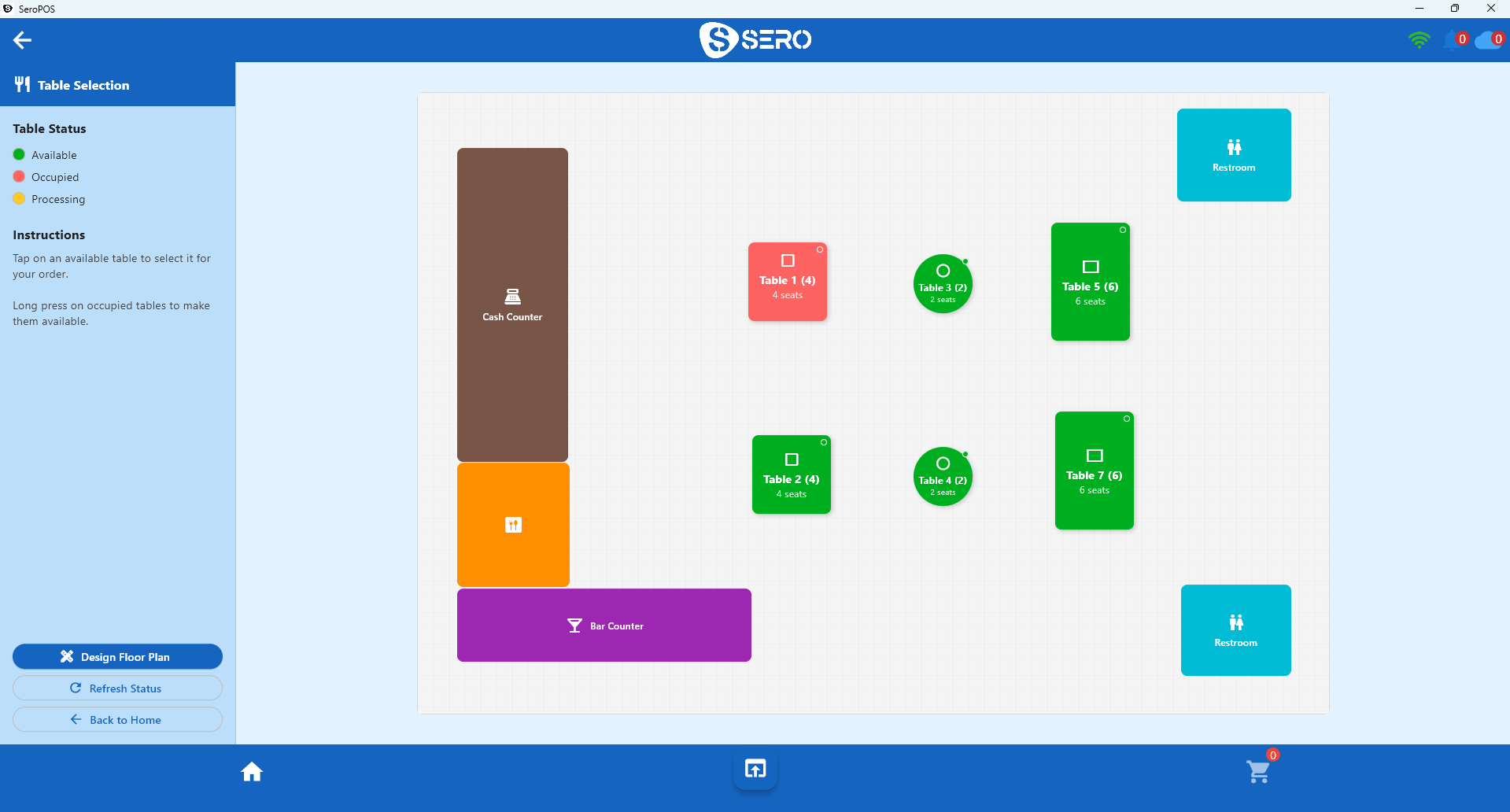
The important part isn’t the drawing; it’s that status is updated by the act of taking and closing orders, rather than requiring someone to remember to update a screen.
Understand your turn time
Turn time = total service time ÷ parties served at that table.
Track it by table and by daypart, then look for the outliers rather than the average:
| Observation | Likely cause |
|---|---|
| One section turns slower | Server workload or station layout |
| Slow across the board at 7 PM | Kitchen capacity, not floor |
| Long gap between parties | Bussing and reset lag |
| Fast turns, low spend | Guests leaving before dessert/coffee |
That last row matters: a fast turn isn’t automatically good. The goal is covers × average spend, not speed alone.
Where the minutes actually hide
Guests don’t want a shorter dinner — they want a shorter wait. Attack these:
1. Seating. Every minute a party stands at the door with empty tables in the room is pure loss. Live status makes this instant.
2. First drinks. Get an order in within two minutes of seating. It sets the pace of the whole meal.
3. Order entry. Tableside ordering removes the walk to the terminal and the transcription error that comes with a notepad.
4. The bill. This is the single biggest reclaimable chunk. The traditional flow — catch attention, ask for bill, wait, hand over card, wait again — can burn 10–15 minutes at a table that’s otherwise finished. Bringing payment to the table, or QR pay-at-table, largely eliminates it.
5. Reset. A table that’s empty but dirty is not available. Assign clear responsibility for the reset.
Seating strategy
- Match party to table. Seating a deuce at a six-top on a busy Friday costs you four covers.
- Balance sections. Three tables seated simultaneously in one server’s section produces slow service everywhere in it.
- Seat toward the room’s strengths. Fill visible areas first — an empty-looking restaurant deters walk-ins.
- Keep flexible furniture. Two-tops that combine into four-tops let the room adapt to the night you actually get.
Reservations, walk-ins, or both
| Approach | Strengths | Risks |
|---|---|---|
| Walk-ins only | Simple, no no-shows | Peaks and troughs, walkouts at peak |
| Reservations only | Predictable, plannable | No-shows, empty tables held |
| Hybrid | Smooths demand, keeps flexibility | Needs discipline at the door |
Most independents do best with a hybrid — reserve a portion of the room, hold the rest for walk-ins, and confirm reservations the same day to cut no-shows.
Connect the floor to the kitchen
Table management and kitchen flow are the same problem viewed from two ends. Orders fired from the table should arrive instantly at the kitchen display or printer, and course timing should be deliberate so a table isn’t held hostage waiting for one plate.
When the floor plan, the order queue, and the kitchen all run in one system, “where is table 9’s main?” is answerable without walking anywhere.
What to measure weekly
- Covers per service — the top-line capacity number
- Average turn time by section
- Average per cheque — the other half of revenue
- Walkouts at peak — direct evidence of lost capacity
Your sales reporting covers most of this, and reading it weekly beats reading it obsessively.
Don’t optimize away the hospitality
A word of caution: every table-management gain should be invisible to the guest. Faster seating, faster drinks, and faster payment feel like good service. Hovering, pre-bussing while people are still talking, and dropping the cheque unasked feel like eviction — and cost you the repeat visit that was worth more than the extra turn.
Floor plans, tableside ordering, and QR payment are all included in SeroPOS — see the restaurant features or download the app for a 14-day free trial.